Otto Kirchheimer’s analysis. •
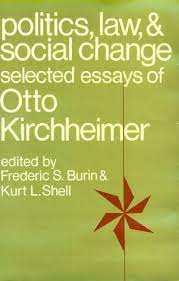
by Yannis Flytzanis
post-doctoral researcher NKUA
Abstract
The paper focuses on the originality of Kirchheimer’s conception of juridification as a complex process that simultaneously captures the dominance of large economic interests, the autonomization of the legal apparatus and, finally, the use of this apparatus for political purposes (re-politicization of juridification). As for the structure of my analysis, I firstly develop Kirchheimer’s premise of juridification, i.e. the differentiation of the social into three relatively autonomous spheres, each of which tends to expand at the expense of the others. Secondly, I select and review three works of the legal theorist that have at their core the scheme of «constitutional legitimacy – legal apparatus at the service of the bourgeoisie». I then propose two readings of juridification: depoliticization, the first, and economization of the political through the legal apparatus, the second. Finally, I attempt some updates and comparisons, contrasting Kirchheimer’s juridification with Foucault’s and Habermas’s currently most influential reflections on the legal apparatus.
Keywords: juridification, rule of law, legal apparatus, law and social theory, political theory.
Introduction
Juridification is one of the central problems of the social theory of law, since it concerns both the over-extension of the legal sphere into other spheres of the social, in an attempt to regulate social life as much as possible, and the densification of law, in an attempt to predict every social practice in the smallest detail. It is therefore a perversion of the function of law, in that the latter, knowing no limits, diffuses horizontally and vertically into the social, thereby losing its particular rationality (its generality and formality)[1] In this paper, I will focus on a particularly original conceptualisation of juridification by the inter-war German legal and political theorist Otto Kirchheimer, who understands it as a complex process of erosion of the rule of law: politics as a means of expressing competing social interests is colonised by the ‘legal apparatus’, which appears as a neutral and peacemaking, post-political instrument for reconciling the social, signaling the supposed end of the great socio-political stakes and class conflicts. But the extended ‘legal apparatus’ works politically for the benefit of the ruling classes by constituting a technique of population management, or in Foucauldian terms, it is part of a gouvernementalité. Juridification in Kirchheimer’s inter-war work is a fundamental as well as complex concept in his theoretical attempt to «reveal the fundamental mechanisms of political order and political disorder in Weimar» (Kirchheimer 1969), i.e. to highlight the expansion of the power of large economic interests through the use of legal and bureaucratic instruments.[2]
I.
In Kirchheimer’s view, the social is divided into three interrelated spheres: economy, politics and law, each of which maintains a relative autonomy[3] The relations between the different spheres of the social are not harmonious but conflictual, as each does not respect the boundaries of the other. In Kirchheimer’s analyses of Weimar, the role of the economy, i.e. monopoly capitalism, in the gradual erosion of the constitution is of crucial importance[4] In particular, he describes the turning of the economy against politics (capitalism against democracy)[5], emphasizing at the same time the creative potential of the political sphere, e.g. for changes in the distribution of resources in favor of the weakest[6] or even for political action in the direction of social democracy, and he illustrates the constitution of a legal mechanism that replaces politics (colonization of political struggles through juridification).[7]
In the economic sphere, Kirchheimer emphasizes that the Weimar Constitution is the temporary articulation of a fragile socio-economic structure[8]: it is the expression of a temporary compromise between opposing social groups and classes; a compromise that is constantly eroding as private interests become gigantic[9]. Moreover, in his view, the rule of law consists of two competing principles: the private principle of individual autonomy and the political principle of the democratic community. However, the emergence of monopoly capitalism, through the concentration of economic power, marks such a strengthening of private powers that the latter, with the help of the legal apparatus (courts and administration), become uncontrolled, eroding the rule of law. As a result, individual freedoms and property rights are transformed into the defense of private monopolies[10]. In particular, and with regard to Part II of the Constitution, which deals with «fundamental rights» and, more specifically, focuses on the guarantee of equality, it is emphasized that the courts intervene by declining any social legislation that favors workers, considering it contrary to the «freedom of human action» and, therefore, unconstitutional[11], opting for a restrictive interpretation of equality, i.e., political-formal equality. As a result, ‘through the protection of equality, the greatest inequality, the existing distribution of goods, is validated’[12]. The legal apparatus applies the guarantees of the second part of the Constitution in such a way that its social objectives are negated, leading to a crisis of law[13]. Under these circumstances, the adoption and implementation of any decision in favor of the weaker social strata, as reformist, social democratic egalitarianism hopes, becomes impossible.
As for the political sphere, Kirchheimer ascribes an emancipatory dynamic to it, linking it to the decision on the organisation of society that marks the transition from formal to substantive equality, transcending legal formalism[14]. Politics can fulfil the ideals of a ‘social democracy’ (Max Adler) that combats economic inequalities. The political sphere therefore goes beyond the existing society, with its divisions and conflicts, and any compromises between the powerful bloc of private interests and workers, which guarantee the minimum possible equality, because it has the potential to propose an essentially new social order[15]. To underline the transformative potential of politics, Kirchheimer draws on a heterogeneous material of historical examples and thinkers. Following the relevant reading of Teubner[16], I mention that Kirchheimer, among other things: asks whether Sorelian violence can be seen as transformative of the political; recalls his supervising professor Carl Schmitt’s conceptualization of politics through decision, the pursuit of homogeneity, and the confrontation of friend and foe; rethinks the October Revolution, where a social class is transformed into constitutive power.
Finally, and with regard to the legal sphere, he observes that the juridifation of politics in Weimar leads to the instrumentalization and perversion of both law and politics in the service of large economic interests, with the result that the constitutive elements of the constitutional state are gradually being transformed[17]. It is worth quoting his description of this particular process of juridification, contained in an article written in 1928 and published in the Political Review, entitled Socialist and Bolshevik theory of the state[18].
The concept of the Rechtstaat […] has gradually undergone profound changes of function. Originally, the Rechtstaat was the timidly wielded weapon of the “propertied and educated» strata who were concerned […] to safeguard their private entrepreneurial activities from the hazards of arbitrary adjudication. But later it became the dividing line between two struggling groups [i.e., property owners and workers], neither of which is willing to regard it as the definitive law regulating the domestic distribution of power. […] Above every administrative function loomed the hierarchy of the courts, which would snatch any decision from the array of social forces [..] into the sphere of the law. In all fields of endeavor things are turned into law (Verrechtlichung); everything is formalized juridically and thereby neutralized. And now begins the true epoch of the Rechtstaat. For this kind of state consists exclusively in its laws. Decisions are felt to be bearable only because they appear colorless and nonauthoritative, and because they seem to emanate from independent judges freely deciding on the basis of their conviction. Thus the paradox has arisen that the value of the decision lies in its character as a legal ruling handed down by a generally recognized legal authority, while on the other hand it embodies only a minimum of decisional content. The state lives off the law; yet it is no longer law (Recht), it is only a legal mechanism […][19].
II.
With regard to the emergence of the legal mechanism as opposed to constitutional legitimacy, I refer in particular to three significant articles by Kirchheimer from the early 1930s. The first is Weimar – and what then?[20], in which he analyzes the organizational foundations of the Weimar constitution (Parliament, Government, President), noting through concrete historical examples in the functioning of constitutional institutions, their inherent commitment to the reproduction of the existing socio-economic system and their inability to advance towards social democracy. Weimar expresses its «given social organization» and its class correlation, and thus its constitution cannot be transformed into a political program in favor of a «content-based organizing principle of society»[21]. Kirchheimer’s reference to the protection of rights in the Weimar Constitution is characteristic: he finds in the constitutional text multiple influences (liberal, socialist, and Catholic) that create expectations for social reforms, but also confusion about the direction of the state[22]. In this case, the judiciary plays a decisive role in favor of the dominant economic status, as it now has the possibility to control the constitutionality of laws, so it opts for a restrictive interpretation of equality against protective labor legislation and prevents expropriations in favor of the public interest by demanding compensation, invoking the protection of private property[23]. The consequence of the legal mechanism is that, despite the Social Democrats’ program and the relevant provisions of the Constitution (see the constitutional provisions of Article 155 on land expropriation and Article 156 on «common ownership of private enterprises»), neither the socialization of enterprises nor the reparcelling of agricultural land is implemented, which in the end favors the large economic monopolies and the large landowners[24]For Kirchheimer, however, the question of the Constitution remains open for the ruling class:
Since the bourgeois strata struggle everywhere to maintain the capitalist system, the fundamentals and essential problems of bourgeois rule are fairly uniform no matter through what political form it might be exercised. Large portions of the bourgeoisie quite rightly regard the difference between political democracy, temporary dictatorship according to Article 48 of the constitution, or permanent dictatorship with suspension of the constitution purely as a matter of expediency. The decision is mainly made from the point of view of what best serves the maintenance of the economic status quo[25].
In the same year (1930) he publishes the article The Limits of Expropriation[26], a study of the institutionalization of expropriation in relation to the legal guarantee of property. In The Limits of Expropriation, the German legal theorist discusses the relevant political theory (from John Locke and Charles Montesquieu to Lorenz von Stein, Ferdinand Lassalle, and Friedrich Julius Stahl), the history of the development of the institution of expropriation from the 19th century to the interwar period (with a focus on the German-speaking world), and the social dynamics (first the rise of the bourgeoisie and its conflict with feudalism, then the emergence of the working class and its competition with the bourgeoisie). Kirchheimer concludes with an analysis of the Weimar Constitution and the article on expropriation (Article 153 of the Weimar Constitution on Property, which contains the relevant provisions on expropriation), which fosters the illusion among social democrats that the institution of expropriation could be the main means to prevent the cartelization of the German economy into a few large economic monopolies, treating the concentration of ownership of the means of production as «an opponent of human freedom»[27]. Of course, social democrats also gave a broader political-economic meaning to the practice of expropriation, anticipating a radicalization of this practice that would go beyond its purely legal character and transform the private capitalist class into a social economy[28]. Kirchheimer notes that Article 153 of the Weimar Constitution does indeed contain a more social conception of property that goes beyond classical liberalism, since the constitutional definition itself states that «the use of property must be in the service of the common interest”. Another reason (for the German legal theorist) for breaking the classical liberal conception of property is that Article 153 must be read in conjunction with the section of the Constitution entitled «Economic Life,» which deals with the overall regulation of the economic process through state intervention on the basis of the common good, thus demonstrating that the enshrinement of a laissez-faire conception is outdated in modern capitalism[29]. In legal practice, however, the specific dynamic of the Weimar Constitution is reversed: Kirchheimer notes that «laws that apparently punished an economically stronger class were rejected as arbitrary in the name of justice,» and consequently the «social system» of the constitution was not applied[30]. Kirchheimer emphasizes that «in a state dominated primarily by advanced capitalist tendencies, nothing is more necessary than the setting of certain limits,» but through the specific operation of the legal apparatus, «the state leaves the field largely free to private forces,» which «can successfully challenge the right of the state to represent the interests of all»[31].
In 1933, together with his colleague Nathan Leites, he writes the article Commentaries on «Legitimacy and Legitimation» on Carl Schmitt[32], in which he clearly distinguishes his position from the analysis of his professor Carl Schmitt and opposes any reactionary polemic aimed at rejecting the existing democratic Constitution. Among other things, he contrasts the Schmittian political ideal of democracy as the expression of a solid, homogeneous identity with examples of heterogeneous societies (Great Britain, France, and the United States) in which democratic institutions function, and argues against the elimination of «parliamentary legitimacy» «by the monolithic nature of referendum legitimacy»[33]. The «political opportunity that Schmitt wants to reserve for the people is the decision yes or no to a question posed by state institutions», i.e. the choice between two predetermined possibilities[34]. Kirchheimer argues in favor of the parliamentary system, which is «the only political system that embodies an institutional guarantee of a change of power, however drastic, with full continuity of the legal order”.[35] He notes that in Weimar there was a “wealth of possibilities for the development [of the provisions] of the constitution”[36], but that their realization required political action; the latter implies confrontation and conflict, as well as the abandonment of any logic of outsourcing, the expectation of solutions from a third party, which is ,in this case, the legal apparatus: a mechanism that is ostensibly neutral because it is above the social forces, but in practice its functioning in interwar Germany shows (in Kirchheimer’s poignant expression) that it is a “conservative upper body representing property interests against the parliament created by general elections”.[37]
III.
At first glance, Kirchheimer’s juridification has a strong polemical character against depoliticization, since it concerns the transfer of material from the political sphere of society to the legal sphere. The force of law means the typification of political stakes through a neutral-formalist legal language, insofar as social antagonisms, especially class antagonisms, which embody opposing and contradictory values, are channeled into legal processes by accepting their peaceful logic. Social confrontation is denervated, transformed into something qualitatively different, because law, by invading politics, fundamentally transforms it; the latter no longer uses its own terminology and practices, but those of the legal field[38].
But if we look more closely at Kirchheimer’s notion of “juridification”, we will see, beyond the political-legal dichotomy, the role of the economic, which colonizes politics and then uses the ‘legal apparatus’ to its advantage. Kirchheimer uses the term “juridification” to describe a complex process that takes place simultaneously in all three spheres of society: strong economic powers undermine the rule of law, while at the same time law is transformed into a management technique for the benefit of the ruling class[39], i.e. a gouvernementalité that incorporates social reactions, since a power apparatus is formed, including courts and administration, which instrumentalizes law and politics. Juridification in this reading is the predominant politics of the ruling class.
Conclusion
By way of conclusion, and in search of possible extensions, I mention a few points:
Firstly, we can relate Kirchheimer’s legal mechanism to the Foucauldian analysis of law in modernity, as the latter becomes a norm, i.e., a mechanism of power that normalizes by homogenizing the population[40]. One advantage of Kirchheimer’s approach over its Foucauldian counterpart, however, is that it retains both the importance of class confrontations and of state sovereignty being challenged – violated by private interests, which makes it particularly relevant as economic inequalities deepen in our time, while the possibility of a mediating role of the state form returns to the forefront of socio-theoretical debate[41]. On the other hand, we can counter that Kirchheimer does not pay sufficient attention to a number of particularly important social claims concerning the constitution of identity, which today take the form of multiple institutional claims, especially gendered claims[42].
Secondly, for Habermas, juridification means the colonization of the lifeworld through a legal mechanism of typification that serves money and bureaucracy, i.e., the efficiency of political-economic systems, so that social integration is achieved not through the principles of an ethics of deliberation but through an instrumental technical discourse[43]. I note, however, that despite Teubner’s[44] assessment that Habermas’s analysis is richer because it is a deepening of Kirchheimer’s notion of juridification, the latter retains some sharp points that are softened in Habermas’s analysis, I mention, for example, social/class conflicts, the contradiction between capitalism and democracy, the role of the ruling classes in the erosion of the constitutional state.
Thirdly, the above analysis of juridification clearly goes beyond the German interwar period and the crisis of Weimar democracy and also concerns the contemporary crisis of the rule of law, since it refers to a complex process that spans all spheres of society and is also present in our time: uncontrolled large economic interests, the neutralization of the transformative potential of the political, and a legal-administrative apparatus that eliminates social claims..
• The present article is the English edited and modified version of my speech at the conference «Societies and Sociologies in the 21st century» (15 October 2022, Athens). My speech in Greek is available in the published proceedings of the conference: https://www.hellenicsociology.gr/sites/default/files/inline-files/eke_conference_book_v8_2.pdf
[1] Habermas, J., Theorie des Kommunikativen Handelns. Zur Kritik der funktionalistischen Vernunft, Band 2, Berlin, Suhrkamp, 1988, pp. 522-547.
[2] In the present paper, I take into account the analysis of the social and legal theorist Gunther Teubner, who argues that Kirchheimer’s notion of juridification should not be conceived unambiguously as the emergence of a «legal mechanism» that destroys the conditions of the political action, but as a new type of politics that marks the reconceptualization of law and politics, since the conditions of operation of both poles are transformed. My account differs from Teubner’s in that, like the German sociologist of law, I see legalization as politics in a different sense, but I also emphasize the economic factor: legalization is primarily about colonization by the big political monopolies, which also use the «legal apparatus» to promote their interests. Moreover, unlike Teubner, I see that Kirchheimer’s theoretical effort could provide us useful insights that are lacking in later elaborations of the concept. Teubner, G., «Man schritt auf allen Gebieten zur Verrechtlichung” – Rechtssoziologische Theorie im Werk Otto Kirchheimers, In Der Einfluß deutscher Emigranten auf die Rechtsentwicklung in den USA und in Deutschland, M. Lutter, E. C. Stiefel, and M.H. Hoeflich (eds), Tübingen, Mohr, 1993, pp. 505-520.
[3] Teubner, «Man schritt auf allen Gebieten zur Verrechtlichung”, op. cit., p. 509.
[4] Thornhill, Ch., German Political Philosophy, The metaphysics of Law, London-New York, Routledge, 2007, p.293.
[5] Buckel, S., Subjectivation and Cohesion. Towards the Reconstruction of a Materialist Theory of Law, M. Vykoukal (Transl.), Leiden-Boston, Brill, 2021, p.86.
[6] Kirchheimer O., “Weimar- and what then?” In Politics, law, and social change: selected essays of Otto Kirchheimer, F. S. Burin and K. L. Shell (eds.), 1969, New York, Columbia University Press, 1969, pp. 40-41.
[7] Kirchheimer, “Socialist and Bolshevik theory of the State”, op.cit., pp. 6-8.
[8] Kirchheimer O., “Weimar- and what then?”, op. cit., pp. 72-74.
[9] Schale F., Klingsporn L. and Buchstein H., “Otto Kirchheimer – Capitalist State, Political Parties, and Political Justice”, In B. Best, W. Bonefeld, Ch. O’Kane (eds.), The SAGE Handbook of Frankfurt School Critical Theory, New York, The Sage, 2018, pp. 107-108.
[10] Thornhill, German Political Philosophy, op. cit., pp. 293-294.
[11] Kirchheimer O. “Weimar- and what then?” op.cit., p. 54.
[12] Ibid., p. 55.
[13] Ibid., pp. 51-60.
[14] Ibid., pp. 38-43.
[15] Schale, Klingsporn and Buchenstein, “Otto Kirchheimer – Capitalist State, Political Parties, and Political Justice”, op. cit., pp.107-110.
[16] Teubner, «Man schritt auf allen Gebieten zur Verrechtlichung”, op. cit., p. 507.
[17] Ibid., p. 506.
[18] Kirchheimer, “Socialist and Bolshevik theory of the State”, op. cit. 3-21.
[19] Kirchheimer O., “Socialist and Bolshevik theory of the State”, op. cit., pp. 6-8.
[20] Kirchheimer O., “Weimar- and what then?” op. cit., pp. 33-74.
[21] Ibid., pp. 72-73.
[22] Ibid., pp. 53-54.
[23] Ibid., pp. 54-56.
[24] Ibid., pp. 57-59.
[25] Ibid., p. 43.
[26] Kirchheimer O., “Remarks on Carl Schmitt’s Legalität und Legitimität ” In Social Democracy and the Rule of Law, Keith Tribe (ed.), Leena Taner and Keith Tribe (transl.), 1987, London, Allen and Unwin, pp. 175-208.
[27]Ibid., pp. 175-208.
[28] Wiggershaus R., The Frankfurt School: Its History, Theories, and Political Significance, Michael Robertson (Transl.), Cambridge, 1995, Massachusetts, MIT, pp. 231-232.
[29] Kirchheimer O. (1987) “The Limits of Expropriation” In Social Democracy and the Rule of Law, Keith Tribe (ed.), Leena Taner and Keith Tribe (transl.), 1987, London, Allen and Unwin, pp. 124-130.
[30] Ibid., p. 129.
[31] Kirchheimer O., “Remarks on Carl Schmitt’s Legalität und Legitimität“, op. cit. pp. 175-208.
[32] Ibid.
[33] Ibid., p. 205.
[34] Ibid., p. 206.
[35] Ibid., p. 200.
[36] Ibid., p. 208.
[37] Ibid., p. 187.
[38] Teubner, G.,“Man schritt auf allen Gebieten zur Verrechtlichung”, op. cit. p. 509.
[39] Thornhill, German Political Philosophy, op.cit., pp. 293-294.
[40] Golder B. (ed.), Re-reading Foucault: On Law, Power and Rights, 2013, London, Routledge.
[41] Streeck W., Buying Time. The Delayed Crisis of Democratic Capitalism, 2013, London-New York, Verso.
[42]Buckel, Subjectivation and Cohesion, op.cit., p. 85.
[43] Habermas, J., Theorie des Kommunikativen Handelns. Handlungsrationalität und gesellschaftliche Rationalisierung, Band 1., 1982, Berlin, Suhrkamp. Habermas, J., Theorie des Kommunikativen Handelns.,op.cit..
[44] Teubner, G., «Man schritt auf allen Gebieten zur Verrechtlichung”, pp. 515-516.
References
Buckel, S. (2021), Subjectivation and Cohesion. Towards the Reconstruction of a Materialist Theory of Law, M. Vykoukal (Transl.), Leiden-Boston, Brill.
Golder B. (ed.) (2013), Re-reading Foucault: On Law, Power and Rights, London, Routledge.
Habermas, J. (1982), Theorie des Kommunikativen Handelns. Handlungsrationalität und gesellschaftliche Rationalisierung, Band 1., Berlin, Suhrkamp.
Habermas, J. (1988), Theorie des Kommunikativen Handelns. Zur Kritik der funktionalistischen Vernunft, Band 2, Berlin, Suhrkamp.
Kirchheimer O. (1969) “Socialist and Bolshevik theory of the State” In Politics, law, and social change: selected essays of Otto Kirchheimer, F. S. Burin and K. L. Shell (eds.), New York, Columbia University Press, pp. 3-21.
Kirchheimer O. (1969) “Weimar- and what then?” In op.cit. pp. 33-74.
Kirchheimer O. (1987) «The Limits of Expropriation», In Social Democracy and the Rule of Law, Keith Tribe (ed.), Leena Taner and Keith Tribe (transl.), London, Allen and Unwin, pp. 103-153.
Kirchheimer O. (1987) «Remarks on Carl Schmitt’s Legalität und Legitimität» In op.cit. pp. 175-208.
Schale F., Klingsporn L. and Buchstein H. (2018) Otto Kirchheimer – Capitalist State, Political Parties, and Political Justice, In The SAGE Handbook of Frankfurt School Critical Theory, B. Best, W. Bonefeld, Ch. O’Kane (eds.), New York, The Sage, pp. 105-122.
Streeck W. (2013), Buying Time. The Delayed Crisis of Democratic Capitalism, London-New York, Verso.
Teubner, G. (1993) «Man schritt auf allen Gebieten zur Verrechtlichung” – Rechtssoziologische Theorie im Werk Otto Kirchheimers, In Der Einfluß deutscher Emigranten auf die Rechtsentwicklung in den USA und in Deutschland, M. Lutter, E. C. Stiefel, and M.H. Hoeflich (eds), Tübingen, Mohr, pp. 505-520.
Thornhill, Ch. (2007), German Political Philosophy, The metaphysics of Law, London-New York, Routledge.
Wiggershaus R. (1995) The Frankfurt School: Its History, Theories, and Political Significance, Michael Robertson (Transl.), Cambridge, Massachusetts, MIT.
 Ετερολογίες