The contribution of Franz Neumann’s political and legal theory.
By Yannis Flytzanis*
Appointed Lecturer in Social Theory and Law & Critical Theory, National and Kapodistrian University of Athens (NKUA)
Introduction
There is a growing debate in contemporary political theory about the recent global spread of authoritarian forces that are gradually eroding the rule of law and its guarantees: These forces violate fundamental freedoms (such freedom of expression, association and peaceful assembly), but also the principle of separation of powers through the rise of the executive; they attack the pluralistic and competitive nature of their societies by promoting homogeneity; they seek a parliament without competing parties and a society without autonomous organizations; they support the concentration of economic power.[1] In this context, I believe that revisiting the theory of Franz Neumann (and by extension Otto Kirchheimer) could offer crucial perspectives for the development of a coherent vision of the rule of law and its challenges in civil society.[2]
Franz Neumann began developing his critical legal and political theory in the Weimar interwar period, when liberal institutions were gradually eroding and the constitutional question remained open to many social forces in Germany.[3] At the same time, political and legal theory was flourishing: Carl Schmitt’s development of decisionism, Hans Kelsen’s pure theory of law and Herman Heller’s concept of the social rule of law. After leaving Germany (1933), Neumann went to England, where he defended a (second) dissertation under the supervision of the political theorist Harold Laski. His dissertation was an attempt to systematically develop a social theory of the rule of law.[4] From 1936 he collaborated with the Frankfurt Institute for Social Research and in 1937 published an article (largely based on his dissertation) in the Institute’s journal on the crisis of the rule of law and the change in legal form entitled The Change in the Function of Law in Modern Society.[5] I will therefore refer primarily to this article in the Zeitschrift für Sozialforschung and his dissertation, but also to other relevant publications of his, in order to try to reconstruct Neuman’s thinking immanently by highlighting important points that can contribute to the formation of a social theorization of the rule of law and its crisis. [6] My point is to emphasize his approach, according to which the rule of law is linked to a competitive bourgeois society that guarantees a minimum level of equality, while it falls into crisis as soon as tendencies towards the concentration of economic and political power prevail.
In reviewing his work, I begin with his central thesis: the rule of law and legal form have relative autonomy and can contribute to the expansion of social equality by opposing the concentration of economic and political power. I then discuss the internal tension between coercion and freedom in the rule of law and how Neumann describes this conflict in capitalism through changes in legal form and social content. The prevalence of coercion is a possibility within the rule of law and is associated with one of its poles. The third point I develop is the way in which the rule of law is undermined by the collapse of both the generality of the legal form and the separation of powers and positivist legal theory. Finally, the fourth point concerns the specific prospects that the rule of law offers for more egalitarian and participatory politics.
1. Beyond the rupture: the political possibility of the rule of law and legal form
The dilemma of disrupting or reforming existing socio-political structures is particularly crucial for critical thinking that orients its analysis towards an increasingly egalitarian society. Particularly with regard to the rule of law, this dilemma involves the question of whether the latter is an ideology aimed exclusively at the reproduction of relations of production (with a class character) or whether it can have a positive effect in the direction of the expected social change (with dimensions beyond the class character).[7] Neumann’s thought intervenes in this dispute by defending the potentiality of the rule of law to promote equality. Above all, he conceives of the rule of law as relatively independent of economic power, insofar as it performs a balancing function by mediating between conflicting interests. Thus, he does not fully identify the rule of law with bourgeois interests and reduce it to a class dimension. Another point I would like to emphasize is that in his analysis of the rule of law, Neumann places particular emphasis on the criterion of the general form of law, highlighting both its social function (the minimum of equality in the social sphere as a necessary condition for the functioning of the general form of law, which in turn guarantees a minimum of equality) and its moral dimension (the safeguarding of individual freedom and equality vis-à-vis power, but also the promise of future social equality).[8] The rule of law and the generality of the legal form are, as already mentioned, crucial concepts that form the core of his thesis. First and foremost, they are intended to have a defensive function by providing a measure of the State’s operation: They offer protection against the concentration of economic power, i.e. against governmental phenomena that imply the supremacy of power over law. They also point to future possibilities: the prospect of a more egalitarian and participatory society (political freedom).
Second, I compare Neumann’s position on the rule of law and legal form with two particularly widespread critical conceptions of law. The first considers the reproduction of the existing system as the internal structural limit of the rule of law. One of the most influential considerations in this direction is the theory of Pashukanis[9], who conceives the legal form and its main concepts (legal subject, contract) in absolute relation to the commodity-producing society. At this point I would like to point out that Neumann also describes the rule of law as an ideology with a disguising function.[10] He associates the rule of law with the rise of the bourgeoisie, the organization of the functioning of competitive capitalism and the mystification of the class relations of exploitation between labor and capital. He also emphasizes the social dynamics and competing interests behind the formal separation of powers. Finally, he critiques natural law theory insofar as it constructs a supra-historical, pre-political human being of an isolated individual with natural rights, the core of which is the right to private property. I will also refer to critical approaches that see law as a flexible material that is used by different power relations to achieve their goals. In Foucault’s example, law is part of a dominant governmentality whose function is to homogenize the population through a formalist discourse (normalization). [11] I would like to emphasise here that Neumann’s work exhaustively describes the rise of a new form of government through an analysis of the characteristic aspects of the erosion of the rule of law caused by the concentration of economic and political power (the collapse of contract law and the separation of powers, the rise of the executive and the theory of decisionism).[12] The difference with previous approaches, as I have already emphasized, is that for Neumann the rule of law and the legal form are not completely determined by the political economy or power relations. He therefore assumes neither a logic of breaking with the rule of law (since it is not exclusively part of the political economy), nor a logic of upgrading power relations (since the rule of law is not exclusively an instrument of these relations); he examines its relative autonomy, the minimum of equality it guarantees, its erosion through the concentration of power (economic and political), but also the possibilities of its expansion.
2. Tensions within the rule of law: freedom and sovereignty, legal form and social content.
Neumann’s second major contribution lies in conceptualizing the rule of law through an internal tension between power and law by examining the changes in legal form and social content under capitalism.[13] Neumann shows that the rule of law functions by balancing two opposing elements: sovereignty and freedom, and, within legal form, by the equilibrium between coercion and law. The erosion of the legal form and the collapse of the rule of law are therefore not the result of an external threat. The crisis exists within the rule of law itself, as its potentiality, which is linked to the fact that one of its poles (that of coercion) succeeds in fully asserting itself. Neumann specializes this model to the capitalist mode of production: Power is translated as the social content of extreme inequality due to the concentration of economic power, the latter being the result of private ownership of the means of production and of the formal nature of equality in contracts. When certain economic interests fully assert themselves, the mediating role of the legal form becomes unfavorable to them, and so they begin to actively promote new forms of regulation. On the other hand, the rule of law, with the generality of its legal form, has a social function, since it presupposes a competition of equal powers in which it plays the role of mediator. Consequently, in the reconstruction I am attempting, I address the periodic tendencies towards the concentration of economic and political power in capitalism (i.e. the tendencies towards coercion), which are made possible by the opportunities offered to certain interests by the rule of law. The latter, however, is relatively independent of these interests, balancing coercion and freedom and presupposing a minimum of equality. It can therefore oppose (as a means and as a value) the concentration of economic power and at the same time promote the deepening of equality.
In particular, with regard to the balancing character of the rule of law: the latter presupposes economic factors of equal power, which implies first and foremost individual freedom and equality among capitalists, as Neumann states the indispensable social condition of the legal form is the existence “of a large number of entrepreneurs of about equal economic power»[14] (the liberal element of the rule of law). Later on, with the emergence of the workers’ movement, the organization of workers into mass parties and trade union organizations is added. Therefore, they negotiate on the basis of equality with the economic powers (monopolies and cartels, which are also organized into employers’ associations) and seek to build institutions of substantial social equality (the social-democratic element of the rule of law)[15] . The material basis of the rule of law is a highly competitive society that has achieved a minimum degree of equality. However, this does not mean that the legal form and the rule of law depend solely on a competitive economy. In his works, he rejects any economic reductionism (in fact, as early as the 1950s, he referred to a class sociology, which he rejected as a simplistic approach to the functioning of the state and politics, since it offered a restrictive vision of society).[16] The rule of law thus has its origins in certain social relations, but it also organizes them through its central institutions (the rule of law and social content are thus intertwined).
With regard to the institutions of the rule of law, which organize social relations through the mediation of force and law, Neumann first emphasizes the generality of the legal form, which guarantees equality before the law, in contrast to the arbitrariness and individual privileges that go hand in hand with the concentration of economic and political power.[17] The criteria of generality can be summarized in three elements: abstract formulation, reference to specific cases and non-retroactivity (the concept of retroactivity refers to the reversal of anticipations in matters of the rule of law).[18] The generality of the laws implies, on the basis of negative/individual freedom, the definition of a series of freedoms (personal, political, economic, social).[19] With regard to the form of the law, Neumann’s theory includes both its rationalizing function, related to the predictability and reliability of the functioning of the law, and what he calls its moral function, i.e., the confrontation of the law with violence by guaranteeing a minimum of freedom and equality before the state[20], a function related to the demands of the French Revolution.[21] Then there is the separation of powers, which organizes, controls and differentiates the power of the state, assigning certain powers to state organs and setting limits for them.[22] The separation of powers limits the power of the executive over the parliament and the judiciary, guarantees the independence of the judiciary against the executive, but also limits the power of the judiciary in relation to the legislature. The role of parliament is central because it is the main institution for mediating between the various interests of a pluralistic society. Parliament is composed of both parties with liberal demands and mass parties (linked to trade unions) that mediate demands for social equality.[23] Finally, legal positivism defends a closed, coherent system of rules within the rule of law, without dissolving it in favor of power. Unlike other legal theories, legal positivism does not reduce the rational meaning of law in relation to politics (like decisionism), nor does it give judges such power that they can supplement or even deny the law and thus become legislators themselves (as in the free law movement).[24]
In Neumann’s own words:
The generality of the law and the independence of judges veil the power of one stratum of society; they render exchange processes calculable and create also personal freedom and security for the poor. All three functions are significant and not only, as is maintained by the critics of liberalism, that of rendering economic processes calculable. We repeat, all three functions are realized in the period of competitive capitalism, but it is of importance to discriminate between them. If one does not draw these distinctions, and sees in the generality of the law, nothing but a requirement of capitalist economy, then of course, one must infer with Carl Schmitt that the general law, the independence of judges, and the separation of powers, must be abolished when capitalism dies.[25]
On the other hand, I note that the predominance of coercion over the generality of the legal form is a possibility of the rule of law itself, and therefore the crisis is endogenous: it is caused by the exploitation of its formal/liberal principles by certain economic interests. As a result, freedom of contract (formal equality) becomes a means of concentrating economic power (social inequality), and consequently, those who have monopolized economic power seek to override contract law through political imperatives. Neumann writes: «The contract becomes the instrument for dislodging free competition, terminating therewith the rule of the contract and of the general law on which the contract in the economic sphere is based.”[26] At this point I depart from the view of monopolistic capitalism and the evolutionism of Austro-Marxism (see, among others, the work of Rudolf Hilferding and Karl Renner).[27] The above view partially influenced Neumann in the interwar period, but he never fully adopted it and moved away from it after 1940. For Austro-Marxism, the stages of economic development are fixed: from competitive capitalism to monopolistic capitalism and from there to socialism. In fact, the Austro-Marxist sociologist of law Karl Renner argues in his work The Institutions of Private Law and their Social Function (1929), [28] argues that in the course of economic development, property loses its initial importance, and labor is socialized until a rationally organized society based on public-law institutions emerges. This is a schematic, mechanistic view that follows a predetermined direction and underestimates the competing dynamics within history. Bypassing the evolutionary elements in Neumann’s work, I read the crisis and disintegration of the rule of law as an inherent tendency. Finally, I point to the problem of the generality of the legal form and the rule of law. Will they remain or will they be abolished as soon as the social content changes, since we have a concentration of economic and political power? As we have pointed out, in a competitive, pluralistic society, content and legal form are not opposites, but complement each other, or, to put it in Marxist terms, base and superstructure coincide. To the extent that the content changes, the rule of law and its basic principles no longer serve certain economic interests, which have become gigantic.[29] As a result, the rule of law is being used by those who want to restore freedom and equality (against the concentration tendencies of capitalism), while the interests that have accumulated economic power push for new forms of regulation.
3. From the crisis of the rule of law to the birth of authoritarianism: the erosion of the legal form
A third dimension of Neumann’s theory that I consider important is that it offers a critical approach to the socio-political order in question, using the rule of law as a measure of the degree to which the state has been undermined by powerful economic forces. Neumann does indeed use the paradigm of the Weimar crisis, but his critique is of enduring relevance because the disintegration of the rule of law that he examines concerns the inherent tendency of capitalism to concentrate (economic and political) power (as I have already emphasized). Through the criteria he establishes for the functioning of the rule of law (the generality of the structure of the legal form, the separation of powers in which the role of parliament is central, and legal positivism), it is possible to examine the way in which the organization of the state has changed in the course of colonization by powerful interests: individual measures and general clauses, the judicial and administrative apparatus, the decline of the central role of parliament, the rise of the free law movement and of institutionalism. In this context, I find a supplementary reading of the work of the interwar critical legal theorist Otto Kirchheimer particularly useful, especially with regard to what he discusses about legal mechanism and juridification (Verrechtlichung).[30]
First, I set out the general framework for the changing conditions of governance, emphasizing that the rule of law, which mediates between the antagonisms of power groups and classes, is gradually losing its balancing character. The result is a capitalism of domination and no longer a confrontation between domination and freedom. The model of competition and equilibrium gives way to an authoritarian model, while parliament is devalued in favor of an administrative-judicial apparatus and the general legal form is replaced by other forms of regulation. I have therefore chosen to emphasize two of Neumann’s relevant concepts that describe the general change: Feudalism[31] and polycracy[32]. The former refers to a state of structural inequality in which special privileges prevail. Neumann explains: «When an interest approaches monopolistic control, its private power becomes quasi-legislative and therefore public […] each such interest affects public welfare in a unique way”.[33] On the other hand, the concept of polycracy refers to a disordered state in which power structures compete without boundaries or competences and public authority degenerates.
As for the changes in the rationality of law, I refer first to the concept of contract, which is at the heart of the rule of law because its essence is equivalence: two parties enter into a contract of equal value.[34] The contract is replaced by the unilateral dictation of conditions, i.e. by a command.[35] Neumann gives concrete examples: Freedom of contract and freedom of enterprise guarantee competition in principle, but in practice, in a cartel economy, it is the evolved and colonized economic interests that determine the market conditions for their competitors. As a result, laws against unfair competition are ineffective in terms of positive freedom of contract, while decrees interfere with contracts by guaranteeing monopoly rents (i.e. favoring large monopolistic groups to raise prices and/or reduce market supply while preventing potential competitors from entering the market). The imbalance of power due to the concentration of economic power leads also to the collapse of the collective bargaining system (the result is the unilateral setting of wages by the monopolies through individual labor contracts and the setting of the minimum wage by the state). The abolition of the contract also means the abolition of the central concept of the legal subject and its replacement by the institution: the independent and active economic subject that concludes contracts is replaced by the institution, whose purpose is the common good. The adoption of the theory of institutionalism by the courts has led to the development of a jurisprudence that considers the company as a community in which a functional link develops between workers and employers, so that in the event of loss of profits by the company, the workers are also liable if they have exercised their right to strike. Institutionalism, in which the institution itself cannot make decisive decisions (e.g. which institution is decisive and which is not) and the general collapse of the concept of contract through a series of decrees, mark the rise of the decision of sovereign power, legitimized by the legal theory of decisionism (the political concept takes precedence over the rational concept of law). [36]
Secondly, the generality of the law (whose criterion is that general, abstract rules must be clearly defined) is weakened by the judge’s frequent recourse to general clauses whose generality is false: extra-legal values are introduced for which there is no univocal perception because their content is understood differently in a pluralistic society.[37] In particular, clauses such as «good faith», «good morals» and «sense of justice» refer to extra-legal concepts and presuppose a uniform ethos with regard to the way in which their content is understood. For example, «good faith» in relation to the payment of wages and «sense of equality and justice» in relation to strikes have completely different meanings depending on social class. Because general clauses imply competing meanings, in practice they give the judge the power to legislate, making the judiciary a key pillar for overturning the generality of laws. General clauses weaken the predictability and certainty of the law because they lead to arbitrary judicial decisions and unequal application of the law. Neumann even points out that the judiciary then becomes «a political organ of the anti-democratic counter-revolution»[38]. For Neumann, the massive use of general clauses is a victory for the free law movement[39], which claims that a number of social factors (public opinion, social facts, economic conditions) must be taken into account in judicial decisions. In this respect, the judge complements or even goes beyond the law, which is a departure from legal positivism, which sees the judge as the spokesperson for the law, which is an expression of the general will. However, Neumann’s rejection of individual measures and general clauses is not a rigid doctrine: these instruments can be used in exceptional cases of excessive concentration of economic power, not to violate the principle of equality, but to restore it. In fact, the concentration of economic power always refers to a special case: monopolies that have assumed gigantic proportions and cannot be standardized by general law. In these circumstances, state intervention is crucial and can be extensive when the concentration of economic power is widespread, but it must be limited until freedom and equality are guaranteed.[40]
The collapse of the separation of powers also means the decline of parliament as an institution for mediating between conflicting social interests, since the concentration of economic power virtually nullifies the importance of any balancing institution. As a result, mass parties expressing demands for social equality are unable to influence state policy, and trade unions have shifted from seeking influence in parliament to trying to seduce the executive. Finally, the proliferation of laws that deal only with general directives, while their specialization is ensured by the ministers in charge, i.e. the ministerial bureaucracy, is also an indicator of the diminishing role of parliament in legislation.[41]
At this point, I would like to mention the critical analysis of the interwar legal theorist Otto Kirchheimer., in which he uses the term » juridification” to refer to the emergence of a legal-administrative apparatus in Weimar Germany, to which the substance of politics is transferred and which appears as a neutral, pacifying and post-political instrument, since it eliminates conflicts through the use of legal terminology that codifies and standardizes, thus discouraging political opposition.[42] In reality, however, it is an authoritarian mechanism that instrumentalizes the law, transforming it into an administrative technique for the benefit of large economic interests and rejecting the hopes of social democrats for reforms in favor of equality through the law. In particular, the Weimar Constitution contains a number of social elements which, in its economic part, guarantee a social system in which labor is protected and the state intervenes in favor of the common good. In addition, the constitutional definition of property (Article 153) stipulates that «its use must serve the common good» and contains provisions on the expropriation of land (Article 155) and the socialization of companies (Article 156). However, the Social Democrats’ aspirations that constitutional legitimacy would prevent the concentration of economic power and radicalize the state toward a social economy were dashed by the confrontation with the judicial and administrative apparatus. In particular, the judges, who now exercised control over the constitutionality of laws, override the social provisions of the constitution and promote the concentration of economic power. I note that Kirchheimer (like Neumann) describes the retreat of politics in favor of the central role of the judge and the administration. However, Kirchheimer does not focus on the rule of law as the main axis of his thinking, i.e. as a measure of defense and as a path of future possibilities, but rather he is concerned with the courts as a power mechanism that exercise a policy in favor of the concentration of economic power, and he therefore proposes (since he sees no prospect of a deepening of the rule of law) a policy of rupture, which is why he asks in his famous essay from the 1930s: » Weimar- and What Then?”. In the same year, Neumann responded it as follows: «The task of socialist politics is to realize these basic rights in practice […] the answer can only be: First try Weimar!”. [43]
4. The rule of law and its perspectives
A final point developed by Neumann that I consider important is that the rule of law contains potentialities for the coming social formation. Thus, the rule of law not only has a defensive value associated with preventing the concentration of economic and political power, or a critical and theoretical utility associated with understanding the erosion of the generality of the legal form, but it also institutionalizes freedoms (which have as their material basis a minimum of social equality) that can be expansively deepened/utilized toward broader political participation aimed at the greatest possible social equality[44]. But before moving on to Neumann’s more detailed post-war analyses of the possibilities of a balanced rule of law (on which I will focus), the pre-war period was preceded by a more radical and directly democratic vision: the rule of law as a temporary compromise model incorporating liberal and social democratic principles linked to a deeper class conflict (capital and labor). The project is the predominance of a (social-democratic) tendency that implies a society of identity between the governed and those in power («direct democracy») and the complete elimination of social inequality (through the socialization of private ownership of the means of production).
The direct-democratic direction, in which the rule of law has a temporary utility, is rejected in Neumann’s post-war work thanks to important reevaluations[45]: above all, the importance of protecting the individual from political power, since the latter has the power to alienate his freedom. This is why the liberal elements of the rule of law are necessary, because they guarantee the rights of the individual through the self-restraint of political power. In this context, Neumann positively reassesses the contribution of individualist liberal thought (which he had previously criticized for its ideological function in reinforcing the idea of an omnipotent, rational, possessive subject) and at the same time revises his position on Rousseau’s theory, since the latter sees political power as permeating the entire political community, as omnipresent, and that nothing can protect the individual from it.
The second point that Neumann questions is the demand for a homogeneous society, free of contradictions and with an identity of purpose. In the post-war phase of his work, he stresses that society remains competitive, that the authoritarian element does not disappear, and that the rule of law must play a mediating role (through representation). He rejects his earlier view that with the socialization of the means of production and the abolition of the fundamental opposition between capital and labour, domination and the need to limit it would cease to exist. He notes that societies remain antagonistic even when the fundamental opposition is eliminated, because other contradictions remain which must be mediated by domination. He also points out that any form of wealth production involves some form of domination which, because it involves violence, must be limited. From this perspective, he criticizes both Andrei Vyshinsky and Soviet legal theory, believing that the collectivism achieved is produced from above in a society that remains competitive. At the same time, he also criticizes the conservative political scientist Carl Schmitt, because in Schmitt’s theory, identity is produced from the outside through constant terror and the expulsion of those who are perceived as enemies.
Neumann’s latter period, in which he reconstructs the perspective of the rule of law (centered on his work The Concept of Political Freedom), is particularly important: the rule of law is no longer understood as a temporary compromise, but as a model of equilibrium that can lead to a deepening of political participation and an increasingly egalitarian society. [46] The transition made possible by the rule of law consists in moving from a negative, restrictive conception of freedom (i.e. resistance to the concentration of economic and political power) to a positive, participatory freedom (i.e. active involvement in shaping the common future through collectives), and from a formal/institutional approach to politics (the doctrine of formal freedom and equality, the separation of powers) to an agonistic approach (through collectives open to society and mobilized by making demands). (This does not mean that the negative perception of freedom and formal elements is rejected/abandoned, but rather that they are enriched).
Neumann stresses that the rule of law guarantees the participation of as many people as possible in politics. The rule of law thus guarantees an active field of action in politics that maximizes its potential. According to the German theorist (especially in his post-war work), politics is intertwined with the economy but has an independent field of action (it is neither completely dependent on the latter nor does it completely control the economy). Moreover, politics in the service of the rule of law (as described above) also has a content: a minimum of equality in the social sphere (a position that Neumann defends throughout his work and in the post-war period). Consequently, legal equality (formal equality, i.e. equality of all before the law) and political equality (universal suffrage and equal access to public office) presuppose a minimum of social equality (no concentration of economic and political power). This minimum of equality can develop into a policy aimed at effectively restricting the right to private ownership of the means of production through a democratically legitimized process: expropriation, redistribution of land and socialization of enterprises. Such a policy is justified by the social function that property must fulfil, and not by theories of natural law that conceive it as a supra-historical ontological category linked to a supposedly eternal category associated with the human being.
In particular, he emphasizes the importance of the voluntarist element of political freedom, which refers to the legitimization of political power and the crisis of representation (alienation from politics), by seeking the greatest possible participation in politics, which is not limited to the formal election of representatives (as intended), but makes it possible to increase pressure on politicians and control them in the exercise of their functions. For him, the necessary social and political infrastructure to support such active politics is to be found in a pluralistic structure[47]. The latter consists of several social forces competing for power in a multi-party system. For Neumann, this means that a number of independent associations are developing (civil society), with trade unions at their center, articulating demands for social equality. These entities take (social democratic) positions on a range of political issues and claim relative autonomy from their (mostly bureaucratized) allied parties. The aim is to keep the allied parties and subsequently parliament (i.e. political society) open to social pressure and to propagate egalitarian demands.
Extensions
In my attempt to reconstruct Neumann’s positions, I have drawn on his conception of the rule of law, in which he defends its relative autonomy, arguing that it can provide protection against the concentration of economic and political power on the one hand, and enable the pursuit of a more egalitarian society on the other. Its constituent elements are freedom and coercion, with the risk of violence and the rise of authoritarianism. One of its essential criteria is the generality of the legal form, i.e. the guarantee of a minimum of equality. Neumann’s work also provides a detailed analysis of the ways in which the rule of law and the legal form can collapse.
In terms of Neumann’s contribution to contemporary theory, it can first be linked to political theories of the crisis of the rule of law. Neumann’s thought can further advance these theories with his emphasis on social dynamics and class conflicts, but also on the transformation of the economy, as well as with his analysis at the level of legal theory. Secondly, Neumann can be associated with the second and third Frankfurt generation, which placed particular weight on the rule of law through legal and political philosophy.[48] However, in contrast to the second and third generations of the Frankfurt School, who seek the founding principles of a reconciled democratic society, Neumann introduces an approach that does not emphasize normativity, but is conflictual and highlights competing interests and class relations within bourgeois society. In relation to contemporary approaches to social theory and law, especially Teubner’s social constitutionalism, Neumann’s theory may be in accordance with the description of the crisis and its emphasis on the economic sphere (emergence of great economic powers, growing inequalities, feudalism), but for Neumann the proposal of legal pluralism is an element of the erosion of the rule of law rather than a solution. Finally, it should be noted that by limiting his analysis to the antagonistic relations between capital and labor, Neumann neglects other particularly important forms of domination (gender, ethnic, racial). [49] Although he does mention (in his post-war work) a pluralistic, competitive society in which the main antagonism is between labor and capital, even if we assume that this main antagonism disappears, other forms of domination will persist. Beyond this general thesis, however, he does not go into a more detailed analysis of other forms of social domination.
* This article is an edited, english version of the the lecture I gave at the NoSoPhi (Paris-I) seminar as a visiting professor in the academic year 2023-2024, at the invitation of Professor Isabelle Aubert whom I would like to thank for her very helpful comments as a respondent, as well as those who participated in the seminar and especially Professor Jean-Francois Kervegan.
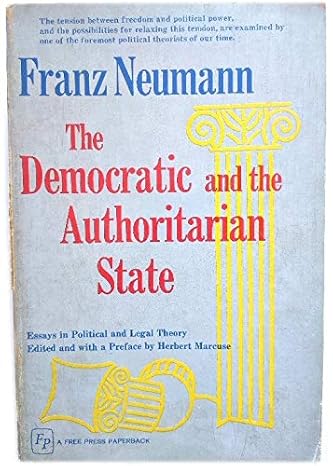
[1] Among others: W. Brown, P. E. Gordon, and Μ. Pensky, Authoritarianism: Three Inquiries in Critical Theory, Chicago: University of Chicago Press, 2018; R. Forst, «The Rule of Unreason: Analyzing (Anti-)Democratic Regression», Constellations 30, n o3 (2023): 217-24, https://doi.org/10.1111/1467-8675.12671; P. Niesen, Zur Diagnose demokratischer Regression: Sonderband Leviathan, Baden-Baden:Nomos, 2023.
[2] See also: W. E. Scheuerman, «Liberal Democracy’s Crisis: What a Forgotten «Frankfurter» Can Still Teach Us», Jus Politicum, n o23 (n. d.).
[3] A. Söllner, «Franz Neumann», Telos 1981, n o50 (December 21, 1981): 171-79, https://doi.org/10.3817/1281050171; A. Söllner, «Franz L. Neumann’’s Place in the History of Political Thought – a Sketch», in Politisches Denken Jahrbuch 2002, ed. by Karl Graf Ballestrem et al., Heidelberg: J.B. Metzler, 2002, 97-110, https://doi.org/10.1007/978-3-476-02766-5_6.
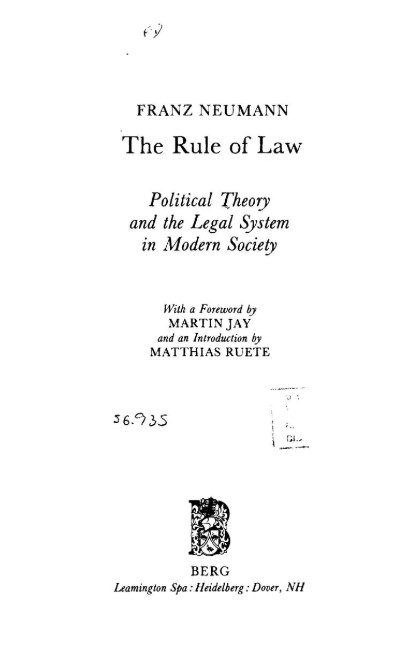
[4] F. L. Neumann The Rule of Law: Political Theory and the Legal System in Modern Society, Oxford: Berg, 1986.
[5] F. L. Neumann, «The Change in the Function of Law in Modern Society», in The Democratic and the Authoritarian State: Essays in Political and Legal Theory, ed. by Herbert Marcuse, London: Free Press, 1964, 22-68.
[6] For another approach, focusing on Neumann’s work on the rule of law, see R. Cotterrell, «The Rule of Law in Transition: Revisiting Franz Neumann’s Sociology of Legality», Social & Legal Studies 5, n o4 (December 1, 1996): 451-70, https://doi.org/10.1177/096466399600500401; R. Cotterrell, «Social Foundations of the Rule of Law: Franz Neumann and Otto Kirchheimer», in Law’s Community: Legal Theory in Sociological Perspective, Oxford: Oxford University Press, 1997.
[7] P. Intelmann, Franz L. Neumann: Chancen und Dilemma des politischen Reformismus, Baden-Baden: Nomos, 1996.
[8] A. Fisahn, Eine kritische Theorie des Rechts: zur Diskussion der Staats- und Rechtstheorie von Franz L. Neumann, Düren and Maastricht: Shaker, 1995.
[9] E. Pashukanis, Law and Marxism: A General Theory, London: Pluto Press, 1989.
[10] Neumann, «The Change in the Function of Law in Modern Society», 39,46.
[11] B. Golder and P. Fitzpatrick, Foucault’s Law, London-N.Y.: Routledge, 2009.
[12] Neumann, «The Change in the Function of Law in Modern Society», 53-66.
[13] H. Buchstein, «A Heroic Reconciliation of Freedom and Power: On the Tension between Democratic and Social Theory in the Late Work of Franz L. Neumann», Constellations 10, n o2 (2003): 228-46, https://doi.org/10.1111/1467-8675.00326.
[14] F. L. Neumann, «The Concept of Political Freedom», in The Democratic and the Authoritarian State: Essays in Political and Legal Theory, ed. by Herbert Marcuse, N.Y.: Free Press, 1964, 168.
[15] Neumann, «The Change in the Function of Law in Modern Society», 47-49.
[16] Franz L. Neumann, «Economics and Politics in the Twentieth Century», in The Democratic and the Authoritarian State: Essays in Political and Legal Theory, ed. by Herbert Marcuse, N.Y.: Free Press, 1964, 257-69.
[17] Neumann, «The Change in the Function of Law in Modern Society», 54-55.
[18] Ibid, 28-29.
[19] Ibid, 30-31; Neumann, «The Concept of Political Freedom».
[20] Neumann, «The Change in the Function of Law in Modern Society», 40.
[21] Neumann, «The Concept of Political Freedom», 167; Neumann, «The Change in the Function of Law in Modern Society», 42.
[22] Neumann, «The Change in the Function of Law in Modern Society», 40-41.
[23] On the balance of opposing forces in the Weimar social Rechtstaat and the role of parliament, see. Neumann, The Rule of Law, 271-73.
[24] Neumann, «The Change in the Function of Law in Modern Society», 37.
[25] Neumann, The Rule of Law, 257.
[26] Neumann, «The Change in the Function of Law in Modern Society», 41.
[27] R. Hilferding, Finance Capital: A Study of the Latest Phase of Capitalist Development, London-N.Y.: Routledge, 2006.
[28] K. Renner, The Institutions of Private Law and Their Social Functions, ed. by Otto Kahn-Freund, trans. by Agnes Schwarzschild, London: Routledge & Kegan Paul, 1949.
[29] This observation lies at the heart of Neumann’s article, «The Change in the Function of Law in Modern Society».
[30] G. Teubner, «Man schritt auf allen Gebieten zur Verrechtlichung» – Rechtssoziologische Theorie im Werk Otto Kirchheimers», in Der Einfluß deutscher Emigranten auf die Rechtsentwicklung in den USA und in Deutschland, ed. by M. Lutter, E.C. Stiefel, and M.H. Hoeflich, Tübingen: Mohr Siebeck, 1993, 505-20.
[31] Neumann, The Rule of Law, 5.
[32] F. Neumann, «On the Preconditions and the Legal Concept of an Economic Constitution», in Social Democracy and the Rule of Law, by Otto Kirchheimer and Franz Neumann, ed. by Keith Tribe, Oxfordshire: Taylor & Francis, 2019, 64.
[33] Neumann, «The Concept of Political Freedom», 171.
[34] Neumann, «The Change in the Function of Law in Modern Society», 31-32.
[35] Ibid, 59-61.
[36] Ibid, 62-64.
[37] Ibid, 54-55.
[38] F. L. Neumann, «On the Limits of Justifiable Disobedience», in The Democratic and the Authoritarian State: Essays in Political and Legal Theory, ed. by Herbert Marcuse, N.Y.: Free Press, 1964, 154.
[39] Neumann, «The Change in the Function of Law in Modern Society», 54-56.
[40] Ibid., 52-53; Neumann, «The Concept of Political Freedom», 172.
[41] Neumann, The Rule of Law, 31″[…] in all these cases, legal norms represent Blanketlnormen – they refer to general norms that are not legal norms».
[42] «Weimar- and What Then?», in Politics, Law, and Social Change: Selected Essays, by Otto Kirchheimer, Columbia: Columbia University Press, 1969, 33-74.
[43] R. Wiggershaus, The Frankfurt School: Its History, Theories, and Political Significance, Cambridge, Massachusetts: MIT Press, 1994, 224.
[44] Neumann, «The Concept of Political Freedom». This post-war essay is crucial to his vision of the positive possibilities of the rule of law.
[45] Consider, e.g., Neumann’s remarks on Rousseau and representation, revising his earlier positions: Ibid, 192-94.
[46] Ibid, 184-194.
[47] J. Bast, Totalitärer Pluralismus: zu Franz L. Neumanns Analysen der politischen und rechtlichen Struktur der NS-Herrschaft, Tübingen: Mohr Siebeck, 1999.
[48] W. E. Scheuerman, Between the Norm and the Exception: The Frankfurt School and the Rule of Law, Cambridge, Massachusetts: MIT Press, 1997.
[49] Sonja Buckel, Subjectivation and Cohesion: Towards the Reconstruction of a Materialist Theory of Law, Leiden: BRILL, 2020.
 Ετερολογίες